The research
Can a substance from your gut slow type 1 diabetes?
BREBAD is a randomised, placebo-controlled phase 2 study run by AmsterdamUMC and Diabeter, funded by BreakthroughT1D. Since January 2026 we have been investigating 6-bromotryptophan in people recently diagnosed with type 1 diabetes.
The video could not be loaded. Please try again later, or email us.
The problem
In type 1 diabetes the immune system attacks the beta cells
The beta cells in your pancreas produce insulin. In type 1 diabetes the immune system mistakes them for foreign tissue and destroys them. At the point of diagnosis, some of those cells are usually still left.
The approach
Internist Prof. Max Nieuwdorp and immunologist Dr Elena Rampanelli focus on the gut. Gut bacteria influence the immune system through substances released when they process food. Some of those signalling molecules appear to dampen autoimmune processes — including in type 1 diabetes.
The evidence so far
Why 6-bromotryptophan in particular?
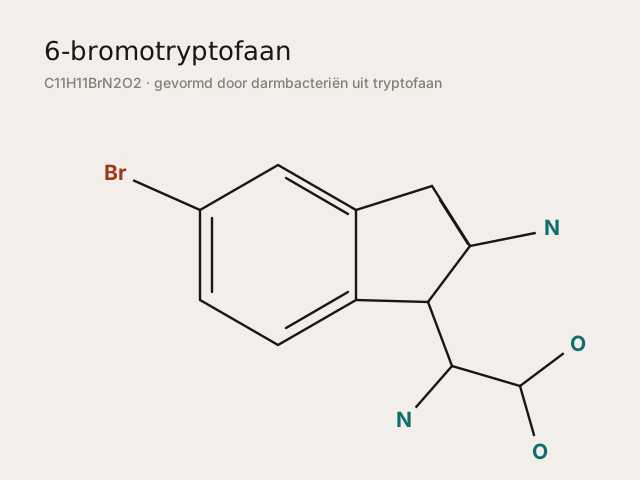
One substance stood out: 6-bromotryptophan (6-BT). It is formed when gut bacteria process the amino acid tryptophan from food — tryptophan is found in dairy, bananas and eggs, among other things.
In laboratory work by our own group, 6-BT was found to protect beta cells against islet inflammation — inflammation of the islets of Langerhans, the clusters in the pancreas where the beta cells sit. That is why we want to raise 6-BT, and not simply the fact that people with type 1 diabetes have less of it.
In humans
What blood studies in people with and without type 1 diabetes show:
- People with type 1 diabetes have on average less 6-BT in their blood than people without diabetes
- Higher 6-BT levels are associated with better preservation of beta cell function in the years after diagnosis
- Higher 6-BT levels are associated with a more favourable immune response
In mice
In mice that develop type 1 diabetes, giving 6-BT led to:
- Better preservation of beta cell function
- Less inflammation of the islets in the pancreas
- Higher endogenous insulin production
The design
How the study is put together
Thirty-four participants from across the Netherlands take part. At the start, their type 1 diabetes diagnosis is at most six months old. By random allocation, one half receives capsules containing 6-BT and the other half a placebo — capsules without active ingredient. Neither the participant nor the researcher knows who receives which. That way we can be confident that any differences we see are genuinely caused by 6-BT and not by expectation.
During the 12 months of treatment and the 6 months that follow, we measure:
- Beta cell function — how much of your own insulin you still produce, measured with a standardised meal test
- Immune response — how your immune system behaves towards the beta cells
- Glucose regulation — including HbA1c, insulin requirement and sensor data
- Safety — side effects and laboratory values are monitored throughout

“My research line aims to identify beneficial bacterial strains and to elucidate the effects of specific microbial metabolites (derivatives of tryptophan metabolism) on endocrine and immune cells in the context of type 1 and type 2 diabetes.”
Dr Elena Rampanelli — immunologist, AmsterdamUMC
Looking ahead
What if it works?
Results are expected in 2029. If 6-BT proves effective, it could help preserve beta cell function for longer and slow the course of type 1 diabetes. Because it involves a substance the body already produces, delivered as a capsule, such a treatment could be low-threshold and widely applicable.
Whatever the outcome, the study will add to what we know about the role of the gut in the development of type 1 diabetes — knowledge that further research can build on.
Further reading
Registrations, news and publications
Official registration
- Dutch national trial register — NL-OMON58422Full protocol registration with the CCMO, via onderzoekmetmensen.nl
- WHO ICTRP — NL-OMON58422International trial registration via the World Health Organization
News and recruitment
- AmsterdamUMCNews item from Amsterdam Cardiovascular Sciences
- DiabeterNews item about the study at Diabeter
- BreakthroughT1DAbout Prof. Nieuwdorp's research and its funding (in Dutch)
- Dutch Diabetes AssociationCall for participants (in Dutch)
- Dutch Diabetes Research FoundationOverview of diabetes studies you can take part in (in Dutch)
Scientific background
- Liu et al. — 6-bromotryptophan in obese diabetic micePreclinical work from the Nieuwdorp and Rampanelli group on which this study builds
- Nederlands Tijdschrift voor Diabetologie‘6-BT als mogelijke behandeling bij vroege type 1-diabetes’ — Dengerink, vol. 24 (2026), no. 1 (in Dutch)
- BROMO trialRelated study on the safety and pharmacokinetics of oral 6-BT in metabolic syndrome
Interested?
Check in one minute whether you can take part
Three short questions, no personal details needed. Not sure? Just send an email — you are not committing to anything.